


Every Second Counts:
Stroke Awareness & Care
A resource microsite for stroke prevention, treatment, and rehabilitation in Malaysia.
What is Stroke?
Every minute without treatment, approximately 1.9 million brain cells die. The faster a stroke patient receives treatment, the better the chance of survival and recovery. Do not wait. Act on the first sign.
CLICK HERE to locate the closest stroke hospital to your location.Stroke occurs when blood supply to part of the brain is cut off — either by a blocked artery (ischaemic stroke) or a burst blood vessel (haemorrhagic stroke). It is Malaysia's third leading cause of death and a major cause of adult disability, yet it is largely preventable.
Signs & Symptoms
Use B.E.F.A.S.T: sudden loss of Balance, changes in Eyesight, Face drooping, Arm weakness, Speech difficulty, and Time to call 999. Symptoms may also include a sudden severe headache, confusion, or difficulty walking.
Diagnosis & Types
Brain imaging (CT or MRI) confirms the type and location of stroke. Ischaemic stroke (blocked artery, ~85% of cases) and haemorrhagic stroke (bleeding in brain) require different treatments and carry different risks.
Risk Factors
High blood pressure, diabetes, high cholesterol, atrial fibrillation, smoking, obesity, and sedentary lifestyle are the primary risk factors. Stroke is increasingly affecting younger Malaysians — 1 in 4 strokes now occur in those under 50.
Treatment & Recovery
Thrombolysis (clot-busting drugs) must be given within 4.5 hours of onset. Thrombectomy mechanically removes clots for eligible patients. Rehabilitation — physiotherapy, speech therapy, occupational therapy — should begin as early as possible and continue long-term.
Stroke in Malaysia
With an estimated 144 strokes occurring every day and annual management costs exceeding RM213 million, stroke is one of Malaysia's most urgent public health challenges. Yet most patients do not receive treatment within the critical early hours.
Delayed Hospital Arrival
Only 21% of stroke patients reach hospital within 3 hours of symptom onset. The median time is 7 hours or more — well beyond the 4.5-hour thrombolysis window — due to poor public awareness and recognition of stroke symptoms.
Very Low Thrombolysis Rate
Only about 0.65–2% of stroke patients in Malaysia receive thrombolysis, far below international benchmarks. Access is concentrated in urban hospitals, leaving rural and regional patients underserved.
Fewer Than 5 Stroke Units Nationwide
Developed countries have stroke units in over 80% of hospitals. Malaysia has fewer than five, mostly in the Klang Valley. Thrombectomy — a key advanced treatment — is unavailable in most states.
Specialist Shortage
The neurologist-to-patient ratio is 1:323,000, with most neurologists in urban centres. Only 31 of 123 registered neurologists practise in Ministry of Health hospitals.
Rehabilitation Gap
55% of post-stroke survivors require partial or complete caregiver dependence. Most patients exhaust insurance coverage for rehabilitation within 2 months, missing the critical 6–12 month recovery window.
No National Stroke Policy
Unlike Thailand, Vietnam, and Indonesia, Malaysia has no national stroke policy. KPIs remain unstandardised, data is fragmented, and there is no coordinated framework linking prevention, acute care, and rehabilitation.
Ongoing projects
 Improving outcomes requires timely, reliable and actionable data across the entire stroke care pathway, from prevention and pre-hospital care to acute treatment, rehabilitation and long-term follow-up. At present, data is often fragmented across institutions and sectors, making it difficult to monitor performance, identify gaps and support evidence-based decision-making.
The Galen Centre is currently working on the development of a prototype national stroke dashboard.
Publications & Resources
Advancing and Optimising Acute Stroke Care in Malaysia

Briefs
 This literature review aims to synthesise current evidence on stroke care, data systems, and performance measurement in Malaysia to inform the development and design of a national stroke dashboard.
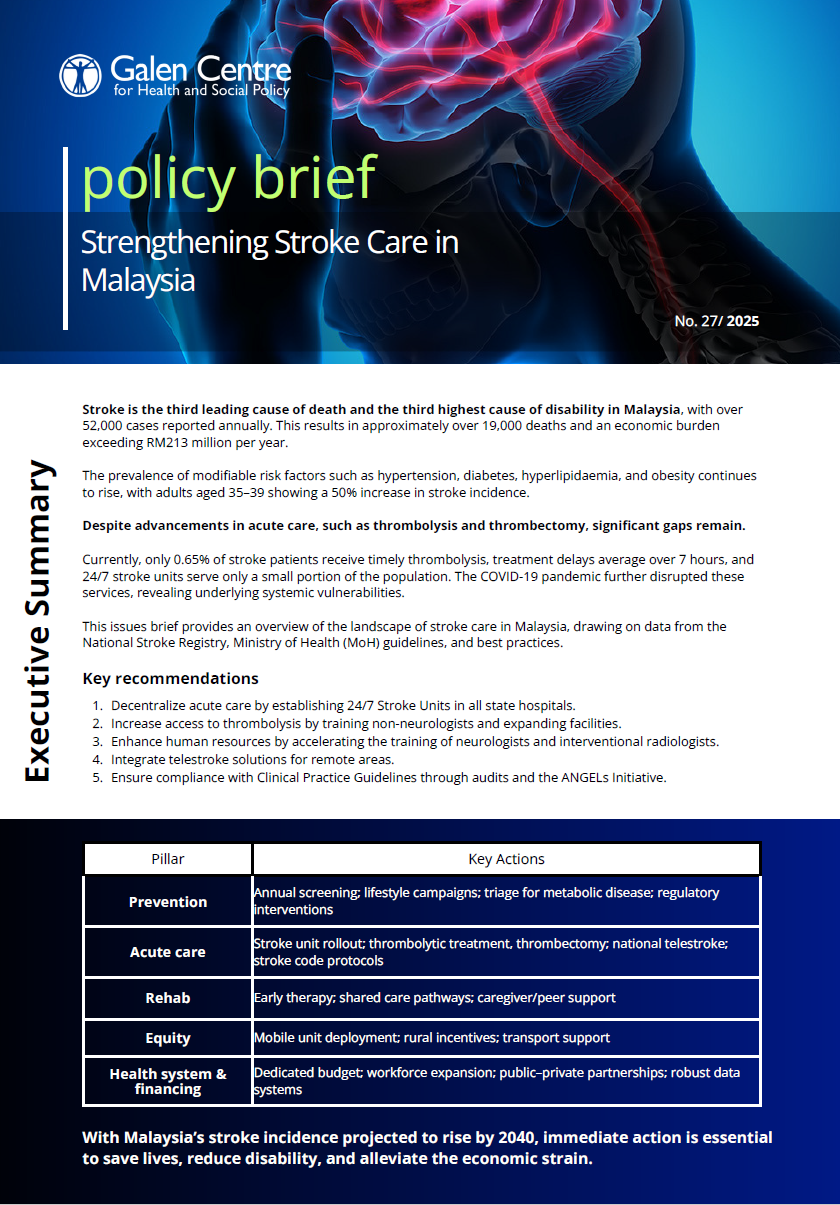 This policy brief provides an overview of the landscape of stroke care in Malaysia, drawing on data from the National Stroke Registry, Ministry of Health (MoH) guidelines, and best practices.

Event Reports
 Roundtable Discussion – Managing the national cost of cardiorenal metabolic diseases: A focus on diabetes and stroke (20 September 2023)
 Symposium – What should Malaysian policy and decision makers know about stroke and how can we do better? (11 August 2022)
Latest Stroke Articles
14 December 2023
19 September 2023
About the Galen Centre
The Galen Centre for Health and Social Policy is a Malaysian think tank dedicated to evidence-based health policy. This microsite is part of our commitment to raising awareness of stroke in Malaysia.